
How much are you actually spending on fuel and what can you do about it?
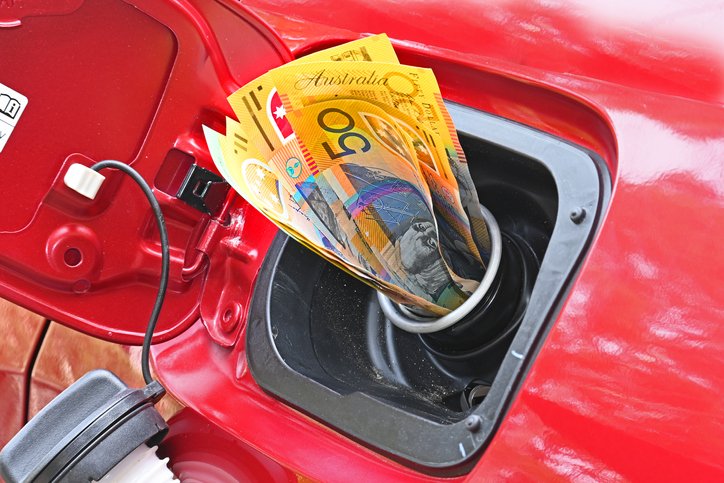
If you've filled up a tank recently, you already know the answer hurts. But most Australians significantly underestimate their total annual fuel spend. The reason we do this is because we experience it in smaller increments; An $80 tap here, $50 there, $10 the day before payday… What we don’t do is see it as a single annual bill. Here we’ll show you the full number, look at what's driving it, and - most importantly - what your options are to reduce it.
How much does the average Australian actually spend on fuel?
Before we get into the numbers, think about the last time you filled up. Did you actually keep track of what you spent that month? Many people don’t.
Let’s look at the figures. The ABS estimates the average Australian driver travels approximately 12,100kms per year and the average fuel efficiency is 11.1 litres/100km. Using Sydney's current average unleaded price of 229.6 cents per litre (NRMA Weekly Fuel Report, 16 March 2026), we can work out the annual spend
12,100 km × 11.1L/100km = 1,340 litres per year
1,340L × $2.30 average = $3,090 per year on petrol. And rising!
That’s over $3,000 a year on fuel alone. And for many people this number will come as a shock.
What’s even worse is that this assumes prices don’t increase - which judging from the AMP modelling cited by The Guardian estimates households are paying an extra $80 per month - roughly $960 per year - compared to what they were spending before the Middle East conflict began. For households with two cars, the annual fuel bill now comfortably exceeds $6,000.
Why can it feel like less than that?
The psychology of fuel spending works against us. We pay in small, frequent amounts which makes it easy to underestimate the cumulative cost. And unlike rent or your mortgage, it’s not something you sit down and budget for. It just sort of… happens. Research in behavioural economics consistently shows that people underestimate recurring small expenses – a tap here and there - compared to single large ones. If your annual fuel bill arrived as one invoice in January, it would feel very different.
Why has it gotten this bad?
Let’s get it out the way. This isn't a normal price cycle. Australia is experiencing a fuel price shock driven by a confluence of factors, some global, some structural, that have pushed prices to levels not seen since the post-Ukraine spike of 2022.
The war in the Middle East and the Strait of Hormuz blockade. It’s not news that the single biggest driver of current prices is war in the Middle East and, more specifically, the blockade of the Strait of Hormuz. Since the blockade began, crude oil and refined fuel benchmark prices have surged. According to the NRMA's Weekly Fuel Report (16 March 2026), the Mogas unleaded benchmark - which directly drives Australian petrol prices - rose $US33.80 per barrel in a single week to $US139.50 per barrel. That is an extraordinary single-week movement.
Prices have risen more than 70 cents per litre in five weeks. Sydney's average regular unleaded price reached 229.6 cents per litre as of Monday 16 March 2026, having risen 70.1 cents per litre from the cycle low point of 15 February 2026, according to the NRMA. Diesel has been hit even harder, reaching 271.1 cents per litre in Sydney, up nearly 50 cents in a single week.
Retailers appear to have raised prices faster than wholesale costs have justified. The ACCC's weekly fuel price monitoring update (13 March 2026) showed that retail prices in some cities rose faster than wholesale prices, with some locations seeing retail prices increase up to 18 cents per litre more than wholesale costs. The ACCC has called on major fuel companies to explain the discrepancy, warning it will take action for misleading conduct.
Australia's structural vulnerability. Unlike the US, which produces much of its own fuel, Australia now imports more than 90% of our daily fuel needs. This is mostly refined product from South Korea, Japan, Singapore, Malaysia and Taiwan. With only two domestic refineries remaining, any disruption to global supply chains hits Australia harder and takes longer to resolve.
Practical ways to use less fuel right now
Some of these require a habit change. Others take about 30 seconds. All of them are worth doing right now.
Check your tyre pressure this week.
Underinflated tyres increase rolling resistance. What this means is that your engine works harder and, most importantly burns more fuel. A study by the National Highway Traffic Safety Administration (NHTSA) in the US confirmed that a 10% decrease in tyre pressure can increase fuel consumption by up to 2%. Reinflating your tyres takes about two minutes at any servo. Check your car's door jamb or owner's manual for the correct PSI.
Strip your car of dead weight.
Every extra kg your engine has to move costs fuel. According to NRMA data, a car loaded to maximum weight can increase fuel consumption by up to 24%. Start with the most obvious culprits: roof racks and roof boxes are major drag offenders even when empty, increasing aerodynamic resistance significantly at highway speeds. If you’re not using them, take them off. While you're at it, check the boot. Take those golf clubs unless you’re heading to the course.
Use a windscreen sunshade.
This one is underrated in the Aussie climate. Every driver knows that a parked car in direct summer sun can get seriously hot. When you get in and blast the air conditioning to cool it down quickly, the aircon places significant load on the engine, increasing fuel consumption by up to 10% in the first few minutes of driving. A cheap sunshade keeps the interior cool enough that the A/C reaches comfort temperatures far faster. And uses considerably less fuel doing so. In a hot Australian summer, this is one of the most cost-effective things you can do. If you don’t have a sunshade, try and find a parking spot in the shade (easier said than done in some cases).
Use your aircon smarter, not less.
Switch your air conditioning to recirculate mode rather than drawing in fresh outside air. The system then cools already-cooled air, which requires less energy (and fuel!). It's a one-button change that can make a difference. At lower, suburban speeds, also consider opening your windows instead of running the A/C. Don’t do this on highways though! At faster speeds the aerodynamic drag from open windows actually costs more fuel than running your aircon would.
Change how you drive, not just where.
Aggressive acceleration and hard braking are among the biggest fuel wasters in everyday driving. Try to allow the car to slow naturally rather than braking hard and then accelerating again. On highways, using cruise control maintains a consistent speed and avoids the incremental fuel burn that comes through minor speed fluctuations.
Combine your errands.
A cold engine uses more fuel than a warm one. Fuel consumption in the first few kms of a trip is higher than during sustained driving. Every time you make a separate short trip from a cold start, you're burning disproportionately more fuel. Batching your errands into a single trip with multiple stops uses less fuel than those same errands done on separate days.
Fill up at the right time.
Although the fuel cycles are slightly out of whack at the moment, the major Australian cities usually follow mostly predictable fuel cycles, offering the opportunity for fuel savings for those who fill up at the right time. The ACCC tracks these cycles, recommending the best time to refuel. Apps like the NSW Government's FuelCheck also show real-time prices at every servo nearby, making it easy to find your cheapest option.

A better solution? Consider Carshare
At a certain point, the question isn’t just how to reduce your fuel bill - it’s whether you need to be paying one at all.
For a lot of urban drivers, especially those who don’t use their car every day or to commute, ownership is just an expensive default. Between fuel, rego, insurance and maintenance… the costs add up quickly. That’s before the horrible fuel prices we’ve seen in the past few weeks. Enter GoGet.
GoGet is Australia's largest carshare network, with 3,000+ cars and vans across Sydney, Melbourne and Brisbane available to be booked by the hour or day. Even better, every GoGet trip includes the cost of fuel - members don’t need to pay out of pocket at the bowser.
For someone who drives a few times a week rather than daily, the savings compared to car ownership can be substantial. GoGet plans start from free in your first year, with cars available from $69/day or $8.50/hr. It’s a great way to maintain access to a car, or especially a second car, when you need it, without the costs of keeping it.
If you’re curious what that could look like for you, you can try GoGet with a free first year on our GoStarter plan. There’s no upfront cost, just pay for the trips you take.
